Demolition guide
Full vs Partial Demolition: Which Fits the Project?
Four questions that resolve which project type you actually have, and why keeping half a building is often not the saving people expect.
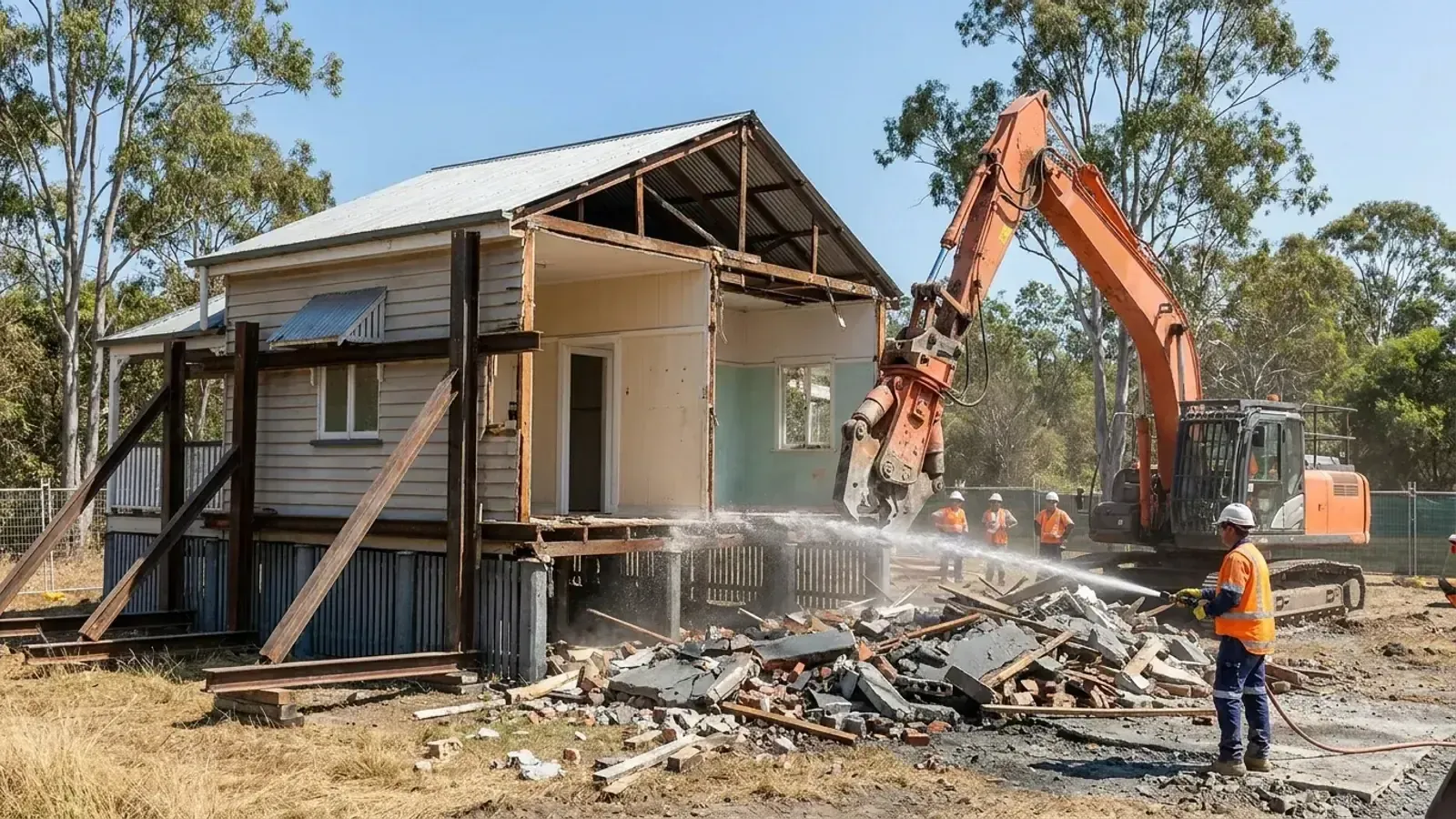
“Should we knock the whole thing down or keep part of it?” is one of the most consequential decisions in a renovation, and it is frequently made on an assumption that turns out to be wrong: that keeping part of the building must be cheaper.
Sometimes it is. Often it is not. Here is how to work out which.
The three project types
| What is removed | What remains | Typically driven by | |
|---|---|---|---|
| Full demolition | Everything above ground; below-ground scope by agreement | A cleared block | Knockdown-rebuild, site clearance, redevelopment |
| Partial demolition | A defined section — a wing, level, annexe or rear | The rest, supported and weathertight | Renovation, extension, retaining a facade |
| Internal strip-out | Fitout, linings, finishes, non-structural partitions | The full structure and shell | Lease make-good, new fitout, interior renovation |
The dividing line between them is simple: how much of the building is still standing when the job is finished?
Four questions that resolve it
1. Is the structure itself sound and worth keeping?
If the frame, footings and roof structure are sound and the layout works, retaining them can be genuinely valuable — it preserves work you would otherwise pay to rebuild.
If the structure has issues, or if the retained section constrains the design badly, you are paying to protect something that is holding the project back.
2. Does what you want to remove carry load?
This is the technical fork in the road.
Removing non-structural elements — linings, non-loadbearing partitions, decks, lightweight additions — is comparatively straightforward.
Removing anything that carries load, braces the structure or supports a roof brings in temporary support, engineering input and usually documentation. Those are prerequisites, not optional extras.
Critically: you cannot tell by looking. A wall can carry load, brace the structure, provide fire separation or carry services, and none of those are visible from the room. If there is any doubt, that check happens before the scope is fixed.
3. Can a machine reach the part being removed?
Machine work is fast. Hand demolition is not.
On a narrow block where the house occupies most of the width, the rear or upper section — exactly what a partial scope usually targets — is often the part a machine cannot reach. Material then has to be broken down and carried out past a structure that must survive undamaged.
That single factor can invert the cost comparison entirely.
4. How long will the retained structure be exposed?
An exposed cut line has to be made weathertight, and on the Gold Coast the storm season makes that a real programme risk rather than a theoretical one. A retained structure left open can take water damage quickly.
Ask: who installs the temporary protection, how soon after removal, and how long does it need to last before the next trade starts? If the answer is “several weeks”, the protection is a scope item with real cost.
Why partial is not automatically cheaper
Five reasons a partial scope can cost more than a full knockdown:
- Precision costs time. A clean interface next to a retained finish is hand work with protection in place.
- Temporary support and engineering are frequently required where a full demolition needs neither.
- Weatherproofing the exposed edge is a real scope item, not an afterthought.
- Protecting the retained portion from dust, vibration and impact takes time and materials.
- Services crossing the cut line need capping or rerouting so the retained part keeps working — sometimes before demolition can start.
None of that means partial is the wrong choice. It means the comparison should be made on real numbers rather than intuition. If the retained portion is small, in poor condition, or expensive to protect, price a full knockdown alongside it — sometimes it is both simpler and cheaper.
Quick decision guide
Choose full demolition when the whole building is being replaced, the structure is not worth retaining, the design needs a clear site, or the retained portion would be small and expensive to protect.
Choose partial demolition when a substantial and sound part of the building is genuinely worth keeping, the design depends on it, and you accept that engineering input, temporary support and weatherproofing are part of the scope.
Choose an internal strip-out when the shell and structure stay entirely and only the interior changes — a tenancy make-good, a defit, or an interior renovation within the existing envelope.
Get advice before choosing when you are not sure whether a wall is loadbearing, whether the building can be extended as designed, or how much of the existing structure the new design actually needs.
Whichever you choose, these still apply
- Approval requirements are property- and scope-specific — a licensed building certifier confirms yours
- Some demolition work must be notified to WorkSafe Queensland at least five days before commencing, and some requires a demolition work licence
- Hazardous-materials assessment applies to partial scopes too, and partial work frequently exposes material hidden in a wall or ceiling cavity right at the interface
- Services need identifying, capping or rerouting in every scenario
What happens next
If you are genuinely undecided, that is a good reason to call rather than a reason to wait. Describe the building, what you want to end up with and what you were hoping to keep, and the project type usually resolves in the first few minutes.