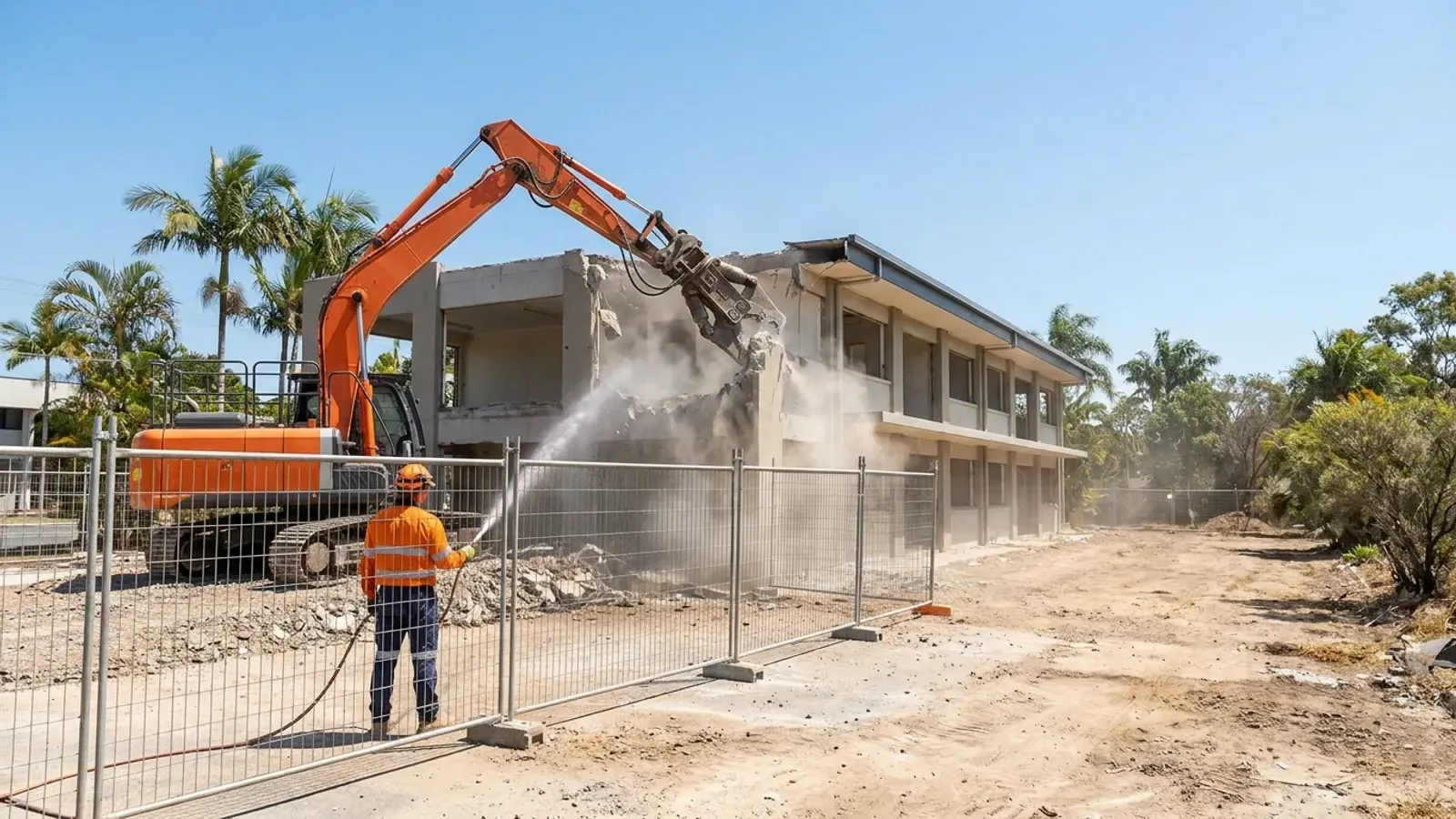
Gold Coast demolition
Commercial Demolition Gold Coast
Commercial demolition is usually less about the structure and more about everything around it — neighbouring tenancies still trading, staged access, shared services and the documentation a building owner or head contractor expects. This page sets out how the scope is normally broken down before you call.
If we miss your call, our automated assistant may text you to continue your service enquiry. Your details may be shared with a suitable independent local provider so they can contact you about the job. See our Privacy Policy.
What this covers
What commercial demolition means on this site
- Standalone commercial buildings, warehouses, retail premises and older non-residential stock
- Staged demolition where part of a site keeps operating
- Structural removal that interfaces with adjoining tenancies or shared building elements
- Coordination expectations between owner, head contractor, certifier and the demolition provider
When a dedicated demolition provider is typically required
- The building or a defined structural portion of it is being removed
- Neighbouring tenancies, car parks or public areas stay in use during the work
- A head contractor or building owner needs documentation, insurances and a programme before site access is granted
- Hazardous materials are recorded in a building’s asbestos register or suspected in older fabric
- Traffic management, public interface or out-of-hours work is likely
Decision aid
How commercial scopes are usually split
Commercial enquiries often arrive as one job and get quoted as several. Identifying which parts apply makes the call far more productive.
| Option | When it fits | Watch for |
|---|---|---|
| Full structural demolition | The building comes down and the site is cleared for redevelopment or sale. | Boundary conditions, shared walls, easements and what happens to slabs, pavements and underground structures. |
| Staged or partial structural removal | One wing, level or annexe is removed while the rest of the building remains in service. | Temporary support, weatherproofing at the cut line and engineering sign-off. See partial demolition. |
| Tenancy strip-out or defit | The structure stays and the fitout is removed back to base building condition. | Retained services, make-good obligations and building-management access rules. See strip out demolition. |
| Hard-surface and external works only | Car parks, slabs, dock areas, awnings or signage structures are removed without touching the building. | Underground services, drainage and how the surface must be left for the next trade. |
Work through the table first — the call is much shorter when the project type is settled.
Cost drivers
What changes the cost of commercial demolition
We do not publish price ranges. We have no verified provider pricing to publish, and a range invented for a website is worse than no number at all. What we can do is set out exactly which inputs move the figure, so you can have an informed conversation with whoever quotes the work.
- Structure and construction system
Tilt-panel, structural steel portal frame, suspended concrete, masonry and mixed-era additions each need different plant and methods, and produce very different volumes of material.
- Site operations during works
If neighbouring tenancies, car parking or loading areas stay in use, the work has to be staged, separated and often carried out outside trading hours.
- Hazardous materials and registers
Commercial buildings may have an existing asbestos register. Licensed removal, clearance and documentation sit ahead of structural work and are usually a separate scope.
- Access, craneage and loading
Truck turning, dock height, internal clearances, crane or hoist requirements and whether plant can reach the structure at all.
- Public and traffic interface
Footpaths, driveways to public roads, hoarding, scaffolding, overhead protection and traffic management add cost and lead time.
- Structural interfaces
Shared walls, party structures, adjoining slabs and services that cross a boundary usually require engineering input and a defined cut line.
- Documentation expectations
Owners and head contractors commonly require method statements, safe work documentation, insurance evidence and licence details before site access.
- Disposal volumes and separation
Concrete, steel and mixed commercial waste are handled differently, and separating streams on a constrained site takes space and time.
Technical detail
The five items that decide the programme
Approvals and certifier considerations
Commercial demolition approval requirements are set by the scope, the building, the zoning and any overlays affecting the land. A licensed building certifier is the appropriate party to confirm the assessment path, and the City of Gold Coast can confirm property and planning information. Separately, some demolition work must be notified to Workplace Health and Safety Queensland at least five days before it commences, and some demolition work requires a demolition work licence. Confirm both the building approval path and the work health and safety obligations early.
Utility disconnection and capping
Commercial sites frequently have services that cross tenancy or title boundaries — electrical submains, fire services, hydraulic risers, data and gas. Identify which services are dedicated to the structure coming down and which serve neighbouring areas that stay in use. Isolation, capping and any temporary reticulation need to be agreed with the building owner and the relevant authorities before work starts.
Asbestos and hazardous materials
Where a building has an asbestos register, provide it early — it materially changes scope and sequencing. Older commercial fabric may contain asbestos in cladding, linings, vinyl, mastics, gaskets and fire-rated elements. Removal of more than 10 square metres of non-friable asbestos requires a Class A or Class B licensed removalist, and friable asbestos requires a Class A licence. Other items worth flagging are refrigerant-containing plant, fuel and chemical storage, contaminated bunding and lighting or fire equipment that needs specific disposal.
Site access and neighbouring property
Useful access details include the widest vehicle the site can accept, dock or gate heights, internal clearances if plant has to work inside the shell, the loading area and whether it is shared, permitted work hours, and whether any part of the work faces a public footpath or road. Where a building is attached to neighbours, note the shared elements.
Debris, disposal and site finish
Commercial projects generate large, separable streams — structural steel, concrete, masonry, plasterboard and fitout material. Confirm whether any plant, equipment or fixtures are being retained by the owner or tenant before work begins. Agree the finish: slab retained, slab removed, footings out, area made safe and fenced, or site prepared for the next contractor.
Site constraints panel
Site constraints that affect commercial demolition
These are the conditions that most often change how a demolition is carried out. None of this is an assessment of your property — it is what a provider will want to know before they can talk about method or price.
Narrow driveway or side access
Plant has to reach the structure. A side access that narrows at a gate, a meter box or a rainwater tank decides whether a machine can work at all.
What to check: Measure the narrowest point between the street and the work area, and the gate opening.
Neighbouring structures and boundaries
Close boundaries, shared fences, adjoining walls and buildings within a few metres usually mean protection and a more controlled sequence of removal.
What to check: Note how close the structure sits to each boundary and whether anything is shared.
Overhead services
Power and communications lines across a frontage or over a work area set minimum clearances and can restrict machine reach or require the supply authority to be involved.
What to check: Note any lines crossing the property or the access route.
Multi-level and loading access
In apartment and commercial buildings, the goods lift, dock and permitted work hours often govern the programme more than the work itself does.
What to check: Confirm the goods lift dimensions and weight limit, dock booking rules and permitted hours.
Known or suspected hazardous materials
Asbestos-containing material generally needs licensed removal before demolition, which sits ahead of the structural work in the programme.
What to check: Say whether an asbestos report or register exists — never try to identify material yourself.
Below-ground structures
Slabs, footings, piers, tanks, pool shells and old pavements add volume and can constrain what is built over the area afterwards.
What to check: List what is under the surface if you know, and what the block has to support next.
Process
What happens after the call
We take the enquiry and may refer it. The independent provider quotes, schedules and performs the work.
-
You call
You describe the property, the project type and your timeframe. It is a phone conversation — there is no form, no booking calendar and no chat widget on this site.
-
Scope and referral
We work out what the job actually is and whether it matches a suitable independent provider. With the required disclosure, your enquiry may be shared with that provider so they can contact you.
-
Provider assessment
The independent provider assesses the site, discusses availability and pricing, and is responsible for their own licences, insurance and the work. We do not quote on their behalf.
-
Approvals, utilities and hazards
A licensed certifier confirms the approval path, services are disconnected or capped, and any licensed asbestos removal is completed. These items usually set the earliest possible start date.
-
Work planning
The provider plans site setup, protection, method, waste handling and the agreed site finish, and schedules the work directly with you.
Materials & site finish
Where the material goes, and how the site is left
Two questions get skipped on most enquiries and then cause friction later: what happens to the material, and what condition the site has to be in at handover. Ask both up front. We do not publish recycling or diversion figures, because we have no verified provider data to publish.
Material streams and the question to ask
- Concrete, brick and masonry
-
Heavy relative to its volume and usually handled as its own stream. Slabs, footings, driveways, paths and pool shells all land here.
Ask: Is the slab in or out of scope, and does the driveway go too?
- Metal
-
Structural steel, roof sheeting, framing, fencing and plant are commonly separated where there is space on site to do it.
Ask: Is there anything metal you want kept rather than removed?
- Timber
-
Framing, flooring, decking and hardwood elements. Salvage has to happen before the structure comes down, not after.
Ask: Is any hardwood or flooring being salvaged, and by whom?
- Mixed and fitout waste
-
Plasterboard, insulation, ceilings, joinery and floor coverings. High volume, and separating it needs somewhere to put it.
Ask: Is there room on site to separate streams, or does everything go mixed?
- Regulated waste
-
Asbestos waste is a separate regulated stream that must go to a facility licensed to receive it, with the required wrapping, transport and documentation.
Ask: Who provides the removal documentation at completion?
Call preparation
What to have ready when you call
You do not need all of it, but the more you have the faster the conversation gets to something useful. Nothing on this page is collected — it is a checklist for the phone call.
- Site address, tenancy or building identifier and current use
- Whether adjoining areas continue trading or operating during the work
- Building type and approximate era (tilt panel, steel portal frame, masonry, suspended concrete)
- Approximate floor area and number of levels
- Whether an asbestos register or hazardous-materials survey exists
- Who the decision maker is — owner, tenant, head contractor or agent
- Documentation the site requires before access is granted
- Permitted work hours and any noise or public-interface restrictions
- Loading, parking and craneage constraints
- The programme date the area must be handed over
Questions
Commercial Demolition questions
The questions that come up most often on this project type.
Can demolition happen while the rest of the site keeps trading?
It is a common requirement and it is what makes commercial scopes complex. It normally means separation, staging, agreed work hours, protected access routes and a defined interface between the work area and the operating area. Flag it on the first call because it changes method and programme, not just price.
Does commercial demolition need to be notified to WorkSafe Queensland?
Some demolition work must be notified to Workplace Health and Safety Queensland at least five days before it commences, and some demolition work requires a demolition work licence. Whether your scope triggers those obligations depends on the structure and the method, so confirm it against current WorkSafe Queensland guidance and with the provider carrying out the work.
What documentation will a provider be asked for?
Owners and head contractors commonly ask for safe work method statements, evidence of insurances, licence details, a programme and waste-handling arrangements. Demolition Gold Coast does not hold or supply those documents — they come from the independent provider who would carry out the work.
We have an asbestos register. Does that speed things up?
It usually helps considerably. A register tells the provider what is recorded, where it is and what condition it was last assessed in, which makes the removal scope and sequencing much easier to plan before anyone is on site.
Do you handle high-rise or industrial demolition?
High-reach, industrial and specialised structural work depends entirely on verified provider capability, plant and licensing. We do not claim access to that capability. Describe the structure when you call and the enquiry will only be referred if a suitable provider is a genuine fit.
Call about your commercial demolition project
Retail, office, warehouse, hospitality and other non-residential structures, including staged and operating-site works. Tell us the suburb, the structure and roughly what is involved.
If we miss your call, our automated assistant may text you to continue your service enquiry. Your details may be shared with a suitable independent local provider so they can contact you about the job. See our Privacy Policy.