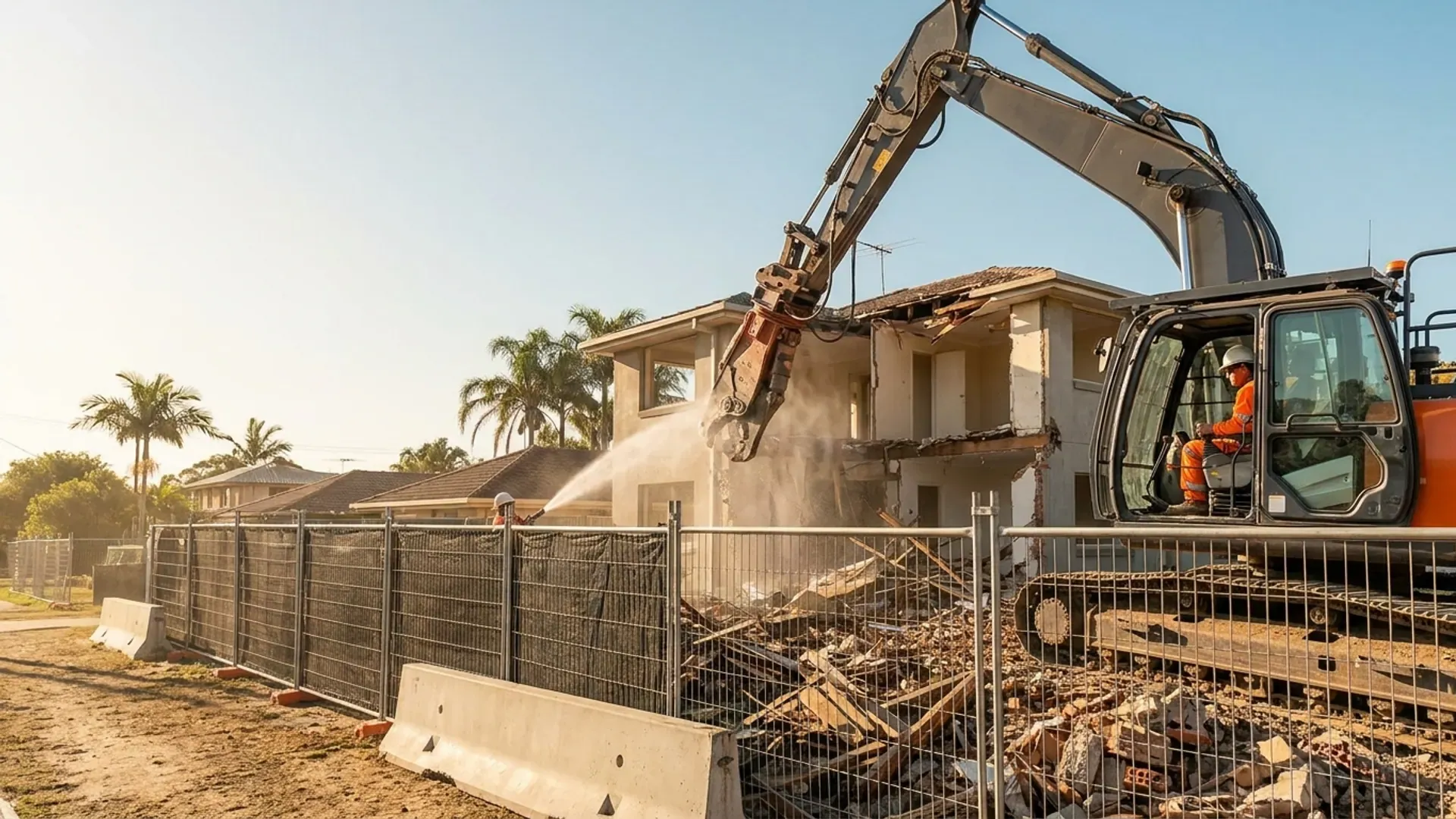
Gold Coast, Queensland
Demolition Gold Coast
Demolition is a high-cost, regulated project, and most of what decides the price and the timeline happens before a machine reaches the site. Work out what your project actually is, then call and talk it through.
Phone is the only way to reach us. There is no form, no booking calendar and no chat widget on this site.
If we miss your call, our automated assistant may text you to continue your service enquiry. Your details may be shared with a suitable independent local provider so they can contact you about the job. See our Privacy Policy.
- House, commercial, strip-out, partial and pool projects
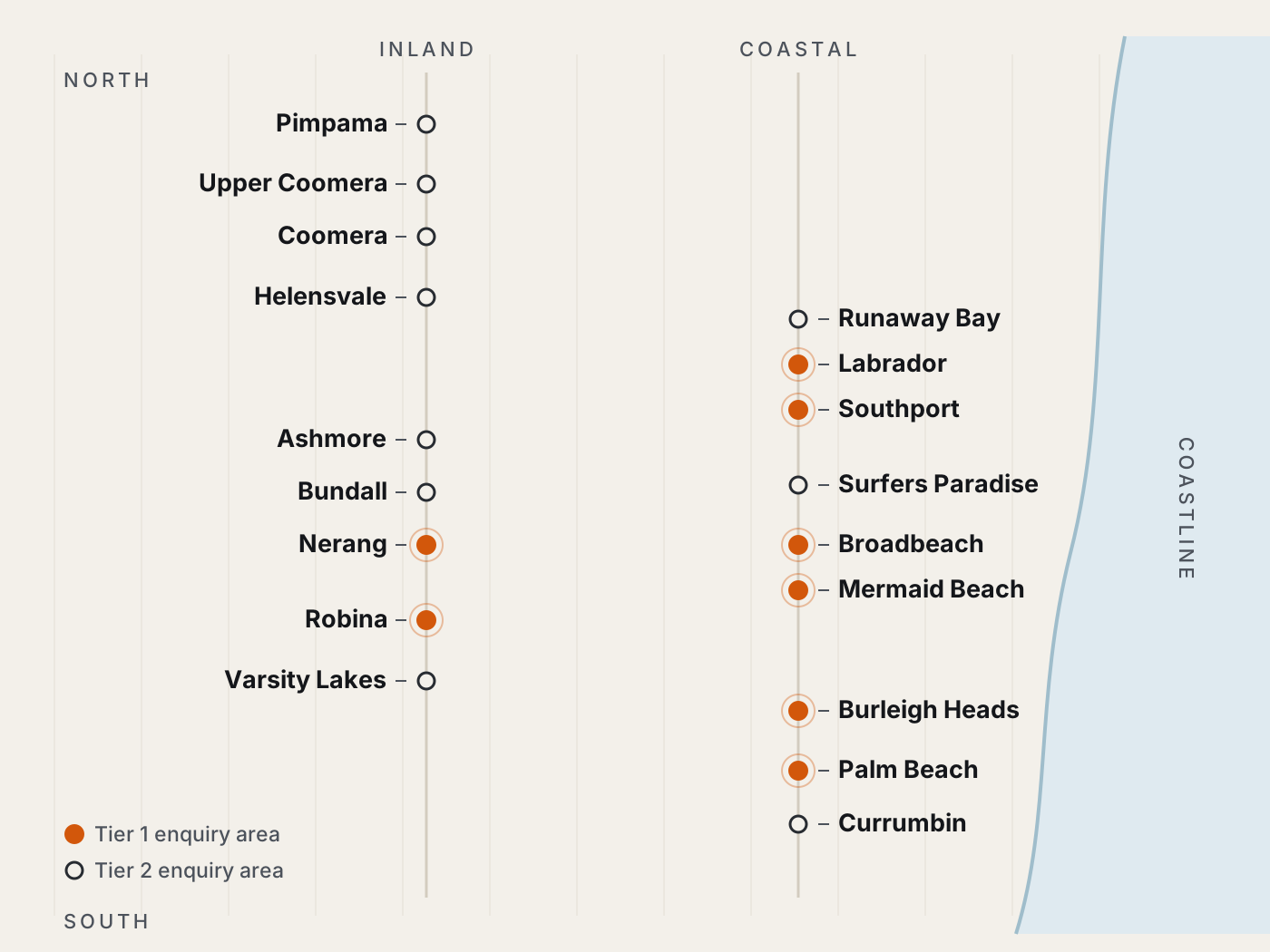
- Tier 1 and Tier 2 enquiry areas across the Gold Coast
- Queensland regulatory context, linked to primary sources
Project type selector
Start with the project type
Most demolition enquiries begin with the wrong label. Pick the closest match and the page will tell you what that project type actually involves — scope, approvals, access, hazards and cost drivers. Nothing here collects your details.
- Full house knockdown House Demolition Detached dwellings, knockdown-rebuild preparation and clearing a residential block back to ground level.
- Commercial building or tenancy Commercial Demolition Retail, office, warehouse, hospitality and other non-residential structures, including staged and operating-site works.
- Internal strip-out or defit Strip Out Demolition Internal demolition, tenancy defits and back-to-base works where the building structure stays in place.
- Part of the building stays Partial Demolition Selective structural or non-structural removal where a defined part of the building remains in place.
- Swimming pool removal Pool Demolition Concrete and fibreglass pool removal or decommissioning, backfill and site reinstatement questions.
- Asbestos is or may be present Asbestos & Demolition Planning a demolition where asbestos is known or suspected, and referral to appropriately licensed providers.
Before you call
Five things that decide a Gold Coast demolition
Five things decide most demolition projects on the Gold Coast. Work through them and the call becomes a short, accurate conversation instead of a guessing exercise. Nothing here is an automated assessment — each row links to an explanation you can check yourself.
-
Scope
Is this a full knockdown, a partial removal, an internal strip-out or a pool?
The project type decides everything downstream — plant, approvals, waste and who is a suitable provider on the Gold Coast.
Compare project types -
Approvals
Has a licensed building certifier confirmed what your property needs?
Approval requirements are property- and scope-specific. A neighbour’s approval path does not transfer to your block.
Read the approvals guide -
Services
Are electricity, water, sewer, gas and telecommunications disconnected or capped?
Demolition cannot start until services are made safe by the relevant authority or a qualified trade. This is usually the longest lead item.
See the preparation checklist -
Asbestos
Does an assessment or asbestos register exist for the building?
WorkSafe Queensland guidance is that asbestos should be removed before demolition so far as is reasonably practicable, by an appropriately licensed removalist.
Understand the asbestos sequence -
Access & site finish
Can plant reach the work area, and how must the site be left?
Driveway width, gradient, overhead lines and the agreed finish standard change the method and the volume of work.
Check the site constraints
Local context
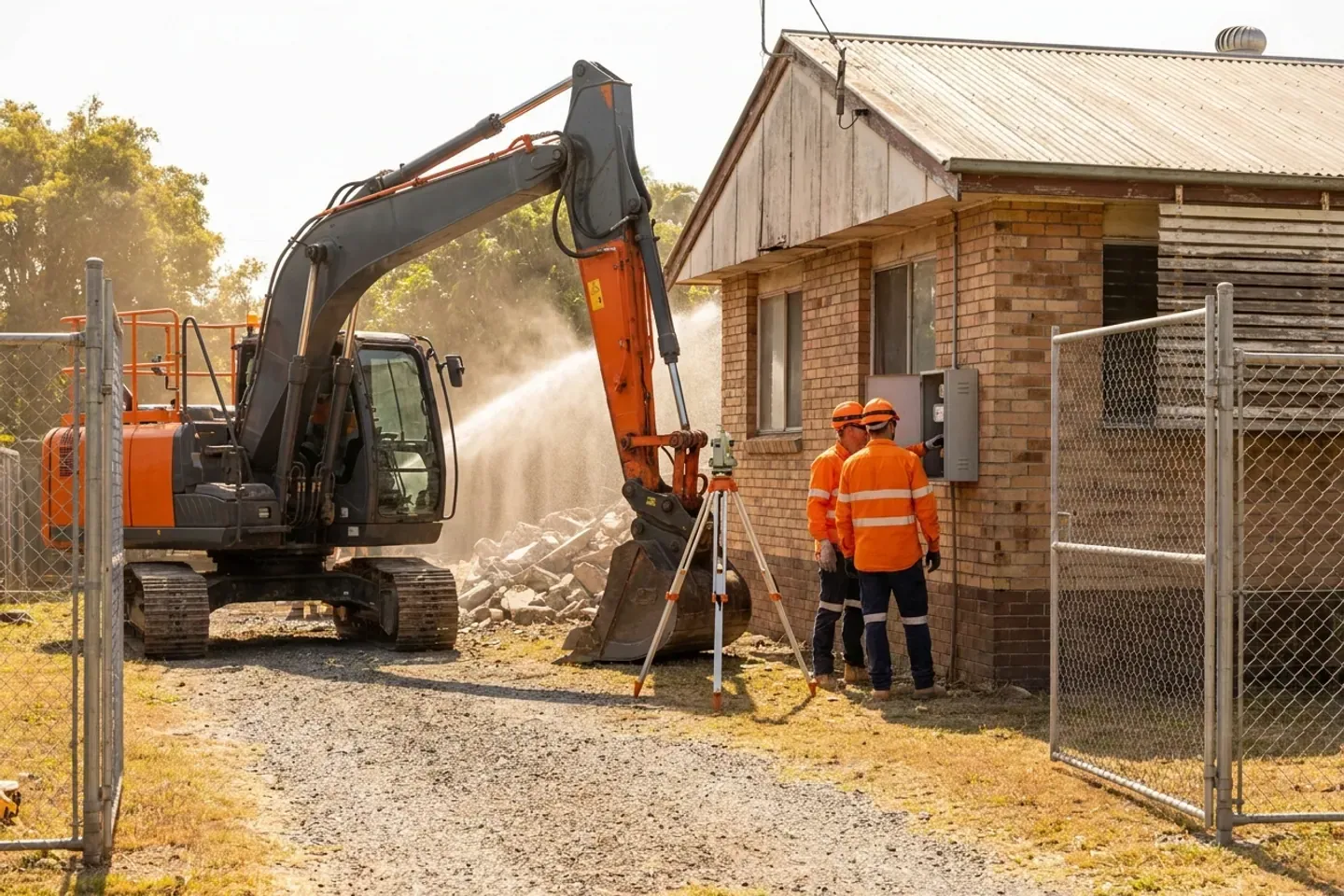
The Gold Coast is not one demolition market
A narrow beachside block in Mermaid Beach, a tenancy on level fourteen in Surfers Paradise and a rural-fringe holding at Upper Coomera have almost nothing in common except the word "demolition". The constraints that matter — access, neighbours, building management, hazardous materials, ground conditions — change completely between them.
- Coastal residential blocks Narrow lots, close boundaries and a single working frontage. Protection of adjoining property and where a truck can stand become the defining constraints.
- High-density and mixed-use buildings The goods lift, loading dock, permitted work hours and building-management approvals usually govern the programme more than the removal itself.
- Established inland and rural-fringe blocks Room to work, but more structures per title, more below-ground surprises and access routes that have to carry loaded trucks.
- Growth corridors Mostly newer housing with selective demolition demand, concentrated on remnant dwellings and outbuildings on land being developed.
Process
Before the excavator arrives
What actually happens between your first call and work starting on site.
-
You call
You describe the property, the project type and your timeframe. It is a phone conversation — there is no form, no booking calendar and no chat widget on this site.
-
Scope and referral
We work out what the job actually is and whether it matches a suitable independent provider. With the required disclosure, your enquiry may be shared with that provider so they can contact you.
-
Provider assessment
The independent provider assesses the site, discusses availability and pricing, and is responsible for their own licences, insurance and the work. We do not quote on their behalf.
-
Approvals, utilities and hazards
A licensed certifier confirms the approval path, services are disconnected or capped, and any licensed asbestos removal is completed. These items usually set the earliest possible start date.
-
Work planning
The provider plans site setup, protection, method, waste handling and the agreed site finish, and schedules the work directly with you.
You will speak to us about the job. Any quote, schedule and the work itself come from an independent provider.
Site constraints panel
Site constraints that change the method
These are the conditions that most often change how a demolition is carried out. None of this is an assessment of your property — it is what a provider will want to know before they can talk about method or price.
Narrow driveway or side access
Plant has to reach the structure. A side access that narrows at a gate, a meter box or a rainwater tank decides whether a machine can work at all.
What to check: Measure the narrowest point between the street and the work area, and the gate opening.
Slope and ground conditions
Sloping blocks change how plant is set up and stabilised, how debris is moved downhill and whether retaining structures are affected.
What to check: Note the fall from street to building platform and whether any retaining walls are in the work area.
Neighbouring structures and boundaries
Close boundaries, shared fences, adjoining walls and buildings within a few metres usually mean protection and a more controlled sequence of removal.
What to check: Note how close the structure sits to each boundary and whether anything is shared.
Overhead services
Power and communications lines across a frontage or over a work area set minimum clearances and can restrict machine reach or require the supply authority to be involved.
What to check: Note any lines crossing the property or the access route.
Multi-level and loading access
In apartment and commercial buildings, the goods lift, dock and permitted work hours often govern the programme more than the work itself does.
What to check: Confirm the goods lift dimensions and weight limit, dock booking rules and permitted hours.
Occupied or trading neighbours
Where adjoining tenancies or dwellings stay in use, the work needs separation, dust and noise control, protected access routes and often out-of-hours staging.
What to check: Note who is still operating next to, above or below the work area.
Street frontage and public interface
Footpaths, kerbside parking, bus routes and busy roads can require hoarding, overhead protection or traffic management before work begins.
What to check: Note whether the site fronts a busy road or a footpath that stays in public use.
Known or suspected hazardous materials
Asbestos-containing material generally needs licensed removal before demolition, which sits ahead of the structural work in the programme.
What to check: Say whether an asbestos report or register exists — never try to identify material yourself.
Below-ground structures
Slabs, footings, piers, tanks, pool shells and old pavements add volume and can constrain what is built over the area afterwards.
What to check: List what is under the surface if you know, and what the block has to support next.
Materials & site finish
Where the material goes, and how the site is left
Two questions get skipped on most enquiries and then cause friction later: what happens to the material, and what condition the site has to be in at handover. Ask both up front. We do not publish recycling or diversion figures, because we have no verified provider data to publish.
Material streams and the question to ask
- Concrete, brick and masonry
-
Heavy relative to its volume and usually handled as its own stream. Slabs, footings, driveways, paths and pool shells all land here.
Ask: Is the slab in or out of scope, and does the driveway go too?
- Metal
-
Structural steel, roof sheeting, framing, fencing and plant are commonly separated where there is space on site to do it.
Ask: Is there anything metal you want kept rather than removed?
- Timber
-
Framing, flooring, decking and hardwood elements. Salvage has to happen before the structure comes down, not after.
Ask: Is any hardwood or flooring being salvaged, and by whom?
- Mixed and fitout waste
-
Plasterboard, insulation, ceilings, joinery and floor coverings. High volume, and separating it needs somewhere to put it.
Ask: Is there room on site to separate streams, or does everything go mixed?
- Regulated waste
-
Asbestos waste is a separate regulated stream that must go to a facility licensed to receive it, with the required wrapping, transport and documentation.
Ask: Who provides the removal documentation at completion?
Call preparation
What to have ready when you call
You do not need all of it, but the more you have the faster the conversation gets to something useful. Nothing on this page is collected — it is a checklist for the phone call.
- Property address and suburb
- Project type — house, commercial, strip-out, partial or pool
- Structure type and approximate age of the building
- Whether an asbestos report or register exists
- Status of service disconnections
- Driveway width, gate openings and access to the work area
- Approximate scope or size, if you know it
- Your timeframe and any fixed programme date
Also covering Surfers Paradise, Ashmore, Bundall, Varsity Lakes, Helensvale, Runaway Bay, Coomera, Upper Coomera, Pimpama, Currumbin — see all enquiry areas.
Call to talk through your demolition
Tell us the suburb, the project type and roughly what is involved. If it matches a suitable independent provider, your enquiry may be shared with them so they can contact you about availability, pricing and the work.
If we miss your call, our automated assistant may text you to continue your service enquiry. Your details may be shared with a suitable independent local provider so they can contact you about the job. See our Privacy Policy.