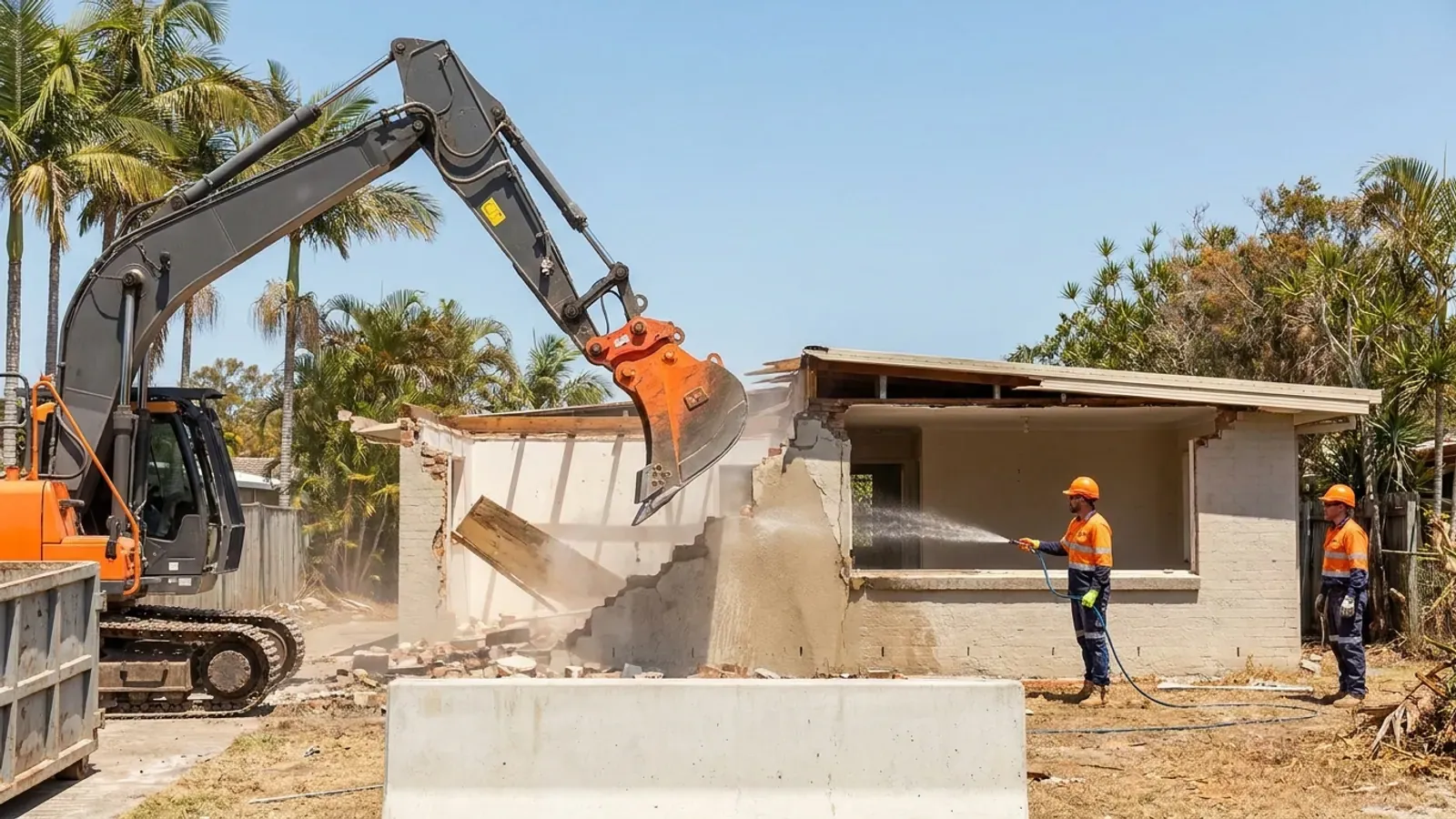
Gold Coast demolition
House Demolition Gold Coast
Removing a detached house is usually the first physical step in a knockdown-rebuild, and most of the cost and timing is decided before a machine reaches the site. This page explains what a demolition provider needs to assess on a Gold Coast block, then you can call and talk through the job.
If we miss your call, our automated assistant may text you to continue your service enquiry. Your details may be shared with a suitable independent local provider so they can contact you about the job. See our Privacy Policy.
What this covers
What house demolition means on this site
- Detached houses, duplexes under single ownership and secondary structures such as sheds, carports and old garages
- Clearing a residential block in preparation for a new build or a rebuild contract
- Slabs, footings, driveways, paths, retaining and fencing where they are part of the same scope
- Site clean-up and the level of finish a builder needs at handover
When a dedicated demolition provider is typically required
- The whole dwelling is coming down, not a section of it
- A builder or designer needs a cleared block by a set date in the build programme
- The house predates the phase-out of asbestos building products and needs a hazardous-materials assessment first
- Sewer, water, power, gas or telecommunications services still run to the dwelling
- A structure sits close to a boundary, a neighbouring dwelling or a retaining wall
Decision aid
Is a full house demolition the right scope?
Homeowners often start with "knock the house down" and discover the real scope is narrower — or wider. Work through the options before you call so the conversation is about the right project type.
| Option | When it fits | Watch for |
|---|---|---|
| Full house demolition | The dwelling is being removed entirely and the block returned to a buildable state. | Confirm what happens to slabs, footings, pools, driveways, retaining and trees — these are separate scope decisions, not automatic inclusions. |
| Partial demolition | Part of the dwelling stays and is extended, raised or rebuilt around. | Retained structure usually needs engineering input and temporary weatherproofing. See partial demolition. |
| Internal strip-out | The shell and roof stay, and only linings, fixtures and services come out. | Very different sequencing and waste stream. See strip out demolition. |
| Removal or relocation | A traditional Queenslander or transportable dwelling may be worth removing whole. | House removal is a distinct trade with its own transport, route and approval requirements. Raise it early so it can be assessed on its merits. |
Work through the table first — the call is much shorter when the project type is settled.
Cost drivers
What changes the cost of house demolition
We do not publish price ranges. We have no verified provider pricing to publish, and a range invented for a website is worse than no number at all. What we can do is set out exactly which inputs move the figure, so you can have an informed conversation with whoever quotes the work.
- Structure type and construction era
Lightweight timber-framed dwellings, rendered brick, brick veneer and full masonry all break down differently and produce different waste streams and machine times.
- Hazardous materials
If asbestos-containing material is present it generally needs to be removed by a licensed removalist before demolition, which adds a separate scope, licensing requirement and clearance step.
- Machine access to the block
Driveway width, gradient, gate openings, overhead services and the ability to bring in a truck and float change how the site is worked and how debris is loaded out.
- Below-ground and hard-surface scope
Slabs, strip footings, piers, pool shells, tanks, driveways, paths and retaining walls each add volume, and concrete is heavy relative to its size.
- Service disconnection status
Demolition cannot start until services are properly disconnected or capped by the relevant authority or a qualified trade. Waiting on that is a common source of delay.
- Disposal and site finish
Where material goes, how much is separated for recycling and how level and clean the block must be at handover all change the volume of work.
- Neighbouring property and protection
Close boundaries, shared fences, adjoining walls and public footpaths can require protection, hoarding or a more controlled sequence of removal.
- Approvals and documentation
Property-specific approval requirements and any notification obligations sit ahead of the physical work and have their own lead times.
Technical detail
The five items that decide the programme
Approvals and certifier considerations
Demolition approval requirements on the Gold Coast are property-specific. They depend on the age and character of the dwelling, the zoning and overlays that apply to the land, and the scope of the work. A licensed building certifier is the right party to confirm what your particular property needs, and City of Gold Coast property and planning enquiries can confirm what applies to the land. Do not assume a neighbour’s approval path applies to your block.
Utility disconnection and capping
Electricity, water, sewer, gas and telecommunications connections need to be disconnected, capped or made safe by the relevant authority or an appropriately qualified trade before demolition begins. Applications can take time, so this is usually the item worth starting earliest. Sewer and stormwater connections also need a decision about capping versus reuse for the new build.
Asbestos and hazardous materials
Asbestos-containing materials were used in Australian residential construction for decades, so older Gold Coast houses commonly need a hazardous-materials assessment before demolition. WorkSafe Queensland guidance is that asbestos should be removed before demolition so far as is reasonably practicable. Removal of more than 10 square metres of non-friable asbestos requires a Class A or Class B licensed removalist, and friable asbestos requires a Class A licence. Other materials worth flagging include lead paint, synthetic mineral fibre insulation and buried rubbish.
Site access and neighbouring property
A demolition provider needs to know how plant gets on and off the block. Useful details are the usable driveway width at its narrowest point, gate and side-access openings, the slope from street to building platform, whether a truck can stand legally on the street, overhead power or communications lines across the frontage, and how close the structure sits to fences and neighbouring buildings.
Debris, disposal and site finish
Concrete, brick, metal, timber and mixed waste follow different disposal routes, and separating them on site takes time and space. Decide early whether anything is being salvaged — appliances, fixtures, hardwood, roof sheets or bricks — because salvage has to happen before the structure comes down, not after. Also agree the site finish: cleared to ground level, footings out, block levelled, or graded and ready for a builder’s set-out.
Site constraints panel
Site constraints that affect house demolition
These are the conditions that most often change how a demolition is carried out. None of this is an assessment of your property — it is what a provider will want to know before they can talk about method or price.
Narrow driveway or side access
Plant has to reach the structure. A side access that narrows at a gate, a meter box or a rainwater tank decides whether a machine can work at all.
What to check: Measure the narrowest point between the street and the work area, and the gate opening.
Neighbouring structures and boundaries
Close boundaries, shared fences, adjoining walls and buildings within a few metres usually mean protection and a more controlled sequence of removal.
What to check: Note how close the structure sits to each boundary and whether anything is shared.
Overhead services
Power and communications lines across a frontage or over a work area set minimum clearances and can restrict machine reach or require the supply authority to be involved.
What to check: Note any lines crossing the property or the access route.
Multi-level and loading access
In apartment and commercial buildings, the goods lift, dock and permitted work hours often govern the programme more than the work itself does.
What to check: Confirm the goods lift dimensions and weight limit, dock booking rules and permitted hours.
Known or suspected hazardous materials
Asbestos-containing material generally needs licensed removal before demolition, which sits ahead of the structural work in the programme.
What to check: Say whether an asbestos report or register exists — never try to identify material yourself.
Below-ground structures
Slabs, footings, piers, tanks, pool shells and old pavements add volume and can constrain what is built over the area afterwards.
What to check: List what is under the surface if you know, and what the block has to support next.
Process
What happens after the call
We take the enquiry and may refer it. The independent provider quotes, schedules and performs the work.
-
You call
You describe the property, the project type and your timeframe. It is a phone conversation — there is no form, no booking calendar and no chat widget on this site.
-
Scope and referral
We work out what the job actually is and whether it matches a suitable independent provider. With the required disclosure, your enquiry may be shared with that provider so they can contact you.
-
Provider assessment
The independent provider assesses the site, discusses availability and pricing, and is responsible for their own licences, insurance and the work. We do not quote on their behalf.
-
Approvals, utilities and hazards
A licensed certifier confirms the approval path, services are disconnected or capped, and any licensed asbestos removal is completed. These items usually set the earliest possible start date.
-
Work planning
The provider plans site setup, protection, method, waste handling and the agreed site finish, and schedules the work directly with you.
Materials & site finish
Where the material goes, and how the site is left
Two questions get skipped on most enquiries and then cause friction later: what happens to the material, and what condition the site has to be in at handover. Ask both up front. We do not publish recycling or diversion figures, because we have no verified provider data to publish.
Material streams and the question to ask
- Concrete, brick and masonry
-
Heavy relative to its volume and usually handled as its own stream. Slabs, footings, driveways, paths and pool shells all land here.
Ask: Is the slab in or out of scope, and does the driveway go too?
- Metal
-
Structural steel, roof sheeting, framing, fencing and plant are commonly separated where there is space on site to do it.
Ask: Is there anything metal you want kept rather than removed?
- Timber
-
Framing, flooring, decking and hardwood elements. Salvage has to happen before the structure comes down, not after.
Ask: Is any hardwood or flooring being salvaged, and by whom?
- Mixed and fitout waste
-
Plasterboard, insulation, ceilings, joinery and floor coverings. High volume, and separating it needs somewhere to put it.
Ask: Is there room on site to separate streams, or does everything go mixed?
- Regulated waste
-
Asbestos waste is a separate regulated stream that must go to a facility licensed to receive it, with the required wrapping, transport and documentation.
Ask: Who provides the removal documentation at completion?
Call preparation
What to have ready when you call
You do not need all of it, but the more you have the faster the conversation gets to something useful. Nothing on this page is collected — it is a checklist for the phone call.
- Property address and suburb
- Approximate age and construction type of the house (timber frame, brick veneer, full masonry, mixed)
- Number of storeys and whether the dwelling is on a slab, stumps or a mix
- Any other structures on the block — shed, carport, garage, pool, retaining walls, large paved areas
- Whether an asbestos report or previous hazardous-materials assessment exists
- Status of service disconnections and who has applied for them
- Driveway width, gate openings and any steep or awkward access
- Whether the block sits close to a neighbouring dwelling or shared boundary structure
- The date the site needs to be clear, and who else is working to that programme
- Photos of the front, rear and access route (useful for the provider conversation later)
Questions
House Demolition questions
The questions that come up most often on this project type.
Do I need approval to demolish a house on the Gold Coast?
Approval requirements depend on your specific property — its zoning, any overlays that apply, the age and character of the dwelling and the scope of work. A licensed building certifier is the right party to confirm what applies, and property and planning information for the land can be checked with the City of Gold Coast. Confirm this early because it sits ahead of the physical work.
What happens to the slab and footings?
That is a scope decision rather than an automatic inclusion. Some rebuild designs need the slab and footings fully removed; others can work around what stays. Tell the provider what your builder or designer expects at handover so the quote reflects the same finish.
Does asbestos have to be removed before the house comes down?
WorkSafe Queensland guidance is that asbestos should be removed before demolition so far as is reasonably practicable. Removal of more than 10 square metres of non-friable asbestos requires a Class A or Class B licensed removalist, and friable asbestos requires a Class A licence. If you suspect asbestos, say so when you call so the enquiry is referred to a provider with the right capability.
How long does a house demolition take?
The physical work on a straightforward detached dwelling is usually short compared with the preparation ahead of it. Service disconnections, approvals and any licensed asbestos removal generally set the real timeline, which is why those items are worth starting first.
Can I keep parts of the house?
Salvage is possible but has to be planned before demolition starts. Fixtures, appliances, hardwood, roof sheeting and bricks all need to come out while the structure is still intact and safely accessible. Raise it on the call so it is priced as part of the sequence.
Call about your house demolition project
Detached dwellings, knockdown-rebuild preparation and clearing a residential block back to ground level. Tell us the suburb, the structure and roughly what is involved.
If we miss your call, our automated assistant may text you to continue your service enquiry. Your details may be shared with a suitable independent local provider so they can contact you about the job. See our Privacy Policy.