Tier 1 enquiry area
Demolition Burleigh Heads
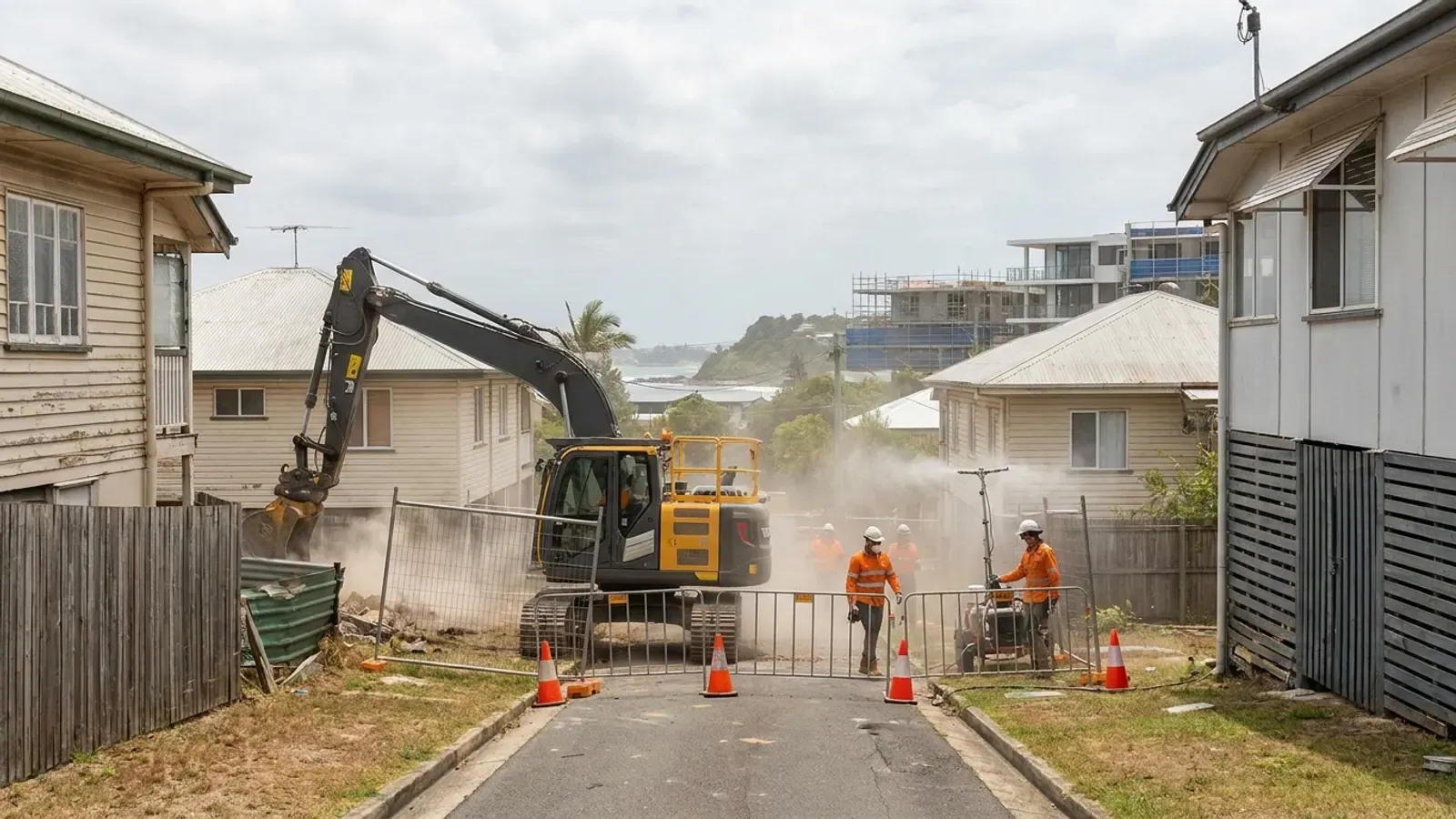
Burleigh Heads combines older coastal housing with sustained redevelopment pressure, and a good deal of it sits on ground that falls away from the street. Slope and access are the two constraints that most often change how a Burleigh job is carried out — a block that would be routine on flat ground becomes a staged, carefully set-up job when plant has to work across a fall or reach a rear section past a narrow side path.
Burleigh Heads is an approved enquiry area. It is not a branch, an office or a local crew.
If we miss your call, our automated assistant may text you to continue your service enquiry. Your details may be shared with a suitable independent local provider so they can contact you about the job. See our Privacy Policy.
Local property context
What demolition in Burleigh Heads usually involves
- Older detached coastal housing, including stock from eras when asbestos-containing products were common
- Renovated and part-renovated dwellings where partial demolition rather than full removal is the real scope
- Low-rise unit buildings and mixed-use premises near the village centre
- Redevelopment sites where an existing dwelling is cleared ahead of a new build
This describes publicly observable property and land-use patterns in Burleigh Heads. It is not a claim about work we have carried out here — no completed local project, crew or office is being implied.
Enquiry status
- Area
- Burleigh Heads, Gold Coast QLD
- Enquiry tier
- Tier 1
- Lead intake
- Approved
- Provider assignment
- Unassigned — matched per enquiry
- Dedicated service pages
- House Demolition, Strip Out Demolition, Partial Demolition
Site constraints panel
Site conditions that come up in Burleigh Heads
These are the conditions that most often change how a demolition is carried out in Burleigh Heads. None of it is an assessment of your property — it is what a provider will want to know before they can talk about method or price.
- Sloping blocks A fall from street to building platform affects how plant is set up and stabilised, how debris moves and whether retaining structures are in the work area.
- Constrained access Narrow streets, limited kerbside standing and tight side access can decide whether a machine reaches the work face or the job becomes hand demolition.
- Retaining walls and levels Where a block is terraced, confirm whether retaining structures stay, because they change both the sequence and what the site looks like at handover.
- Close neighbours Older coastal blocks are often close together, so protection of adjoining dwellings and shared boundary structures is a normal part of scope.
Slope and ground conditions
Sloping blocks change how plant is set up and stabilised, how debris is moved downhill and whether retaining structures are affected.
What to check: Note the fall from street to building platform and whether any retaining walls are in the work area.
Narrow driveway or side access
Plant has to reach the structure. A side access that narrows at a gate, a meter box or a rainwater tank decides whether a machine can work at all.
What to check: Measure the narrowest point between the street and the work area, and the gate opening.
Neighbouring structures and boundaries
Close boundaries, shared fences, adjoining walls and buildings within a few metres usually mean protection and a more controlled sequence of removal.
What to check: Note how close the structure sits to each boundary and whether anything is shared.
Known or suspected hazardous materials
Asbestos-containing material generally needs licensed removal before demolition, which sits ahead of the structural work in the programme.
What to check: Say whether an asbestos report or register exists — never try to identify material yourself.
Below-ground structures
Slabs, footings, piers, tanks, pool shells and old pavements add volume and can constrain what is built over the area afterwards.
What to check: List what is under the surface if you know, and what the block has to support next.
Project type selector
Which demolition project is it in Burleigh Heads?
These are the project types that come up most often in Burleigh Heads. Where a dedicated Burleigh Heads page exists, the link goes straight to it; the rest open the citywide page. Nothing here collects your details.
- Full house knockdown House Demolition Detached dwellings, knockdown-rebuild preparation and clearing a residential block back to ground level.
- Part of the building stays Partial Demolition Selective structural or non-structural removal where a defined part of the building remains in place.
- Internal strip-out or defit Strip Out Demolition Internal demolition, tenancy defits and back-to-base works where the building structure stays in place.
- Asbestos is or may be present Asbestos & Demolition Planning a demolition where asbestos is known or suspected, and referral to appropriately licensed providers.
- Swimming pool removal Pool Demolition Concrete and fibreglass pool removal or decommissioning, backfill and site reinstatement questions.
After the call
What happens to a Burleigh Heads enquiry
We discuss the job by phone and work out whether it matches a suitable independent provider. If it does, your enquiry may be shared with them so they can contact you about availability, pricing and the work. The provider holds their own licences and insurance and performs the work — we do not.
Call preparation
What to have ready for a Burleigh Heads call
You do not need all of it, but the more you have the faster the conversation gets to something useful. Nothing on this page is collected — it is a checklist for the phone call.
- Street and suburb — Burleigh Heads and the nearest cross street
- Sloping blocks — what applies at your Burleigh Heads property
- Constrained access — what applies at your Burleigh Heads property
- Retaining walls and levels — what applies at your Burleigh Heads property
- Close neighbours — what applies at your Burleigh Heads property
- Project type — house, commercial, strip-out, partial or pool
- Whether an asbestos report or building register exists
- Whether services are still connected, and who has applied for disconnection
- Your timeframe and any fixed programme date
Questions
Burleigh Heads demolition questions
My Burleigh Heads block slopes steeply. Is that a problem?
It is a normal Burleigh condition rather than a blocker, but it changes the method. Plant needs a stable working platform, debris movement has to be controlled downhill, and any retaining structures in the work area need a decision about whether they stay. Describe the fall when you call.
Can a machine get to the rear of a Burleigh Heads property?
It depends on the side access. Measure the narrowest point between the street and the rear, and note any steps or steep sections. Where a machine cannot reach, the work shifts toward hand demolition or craning plant in, which is a different scope.
Call about a demolition in Burleigh Heads
Describe the property, the project type and the access, and we can work out quickly whether it is something that can be matched to a suitable independent provider.
If we miss your call, our automated assistant may text you to continue your service enquiry. Your details may be shared with a suitable independent local provider so they can contact you about the job. See our Privacy Policy.