Demolition guide
Asbestos Before Demolition in Queensland
The removal sequence, the licence classes, and why the asbestos scope usually sets the earliest date demolition can start.
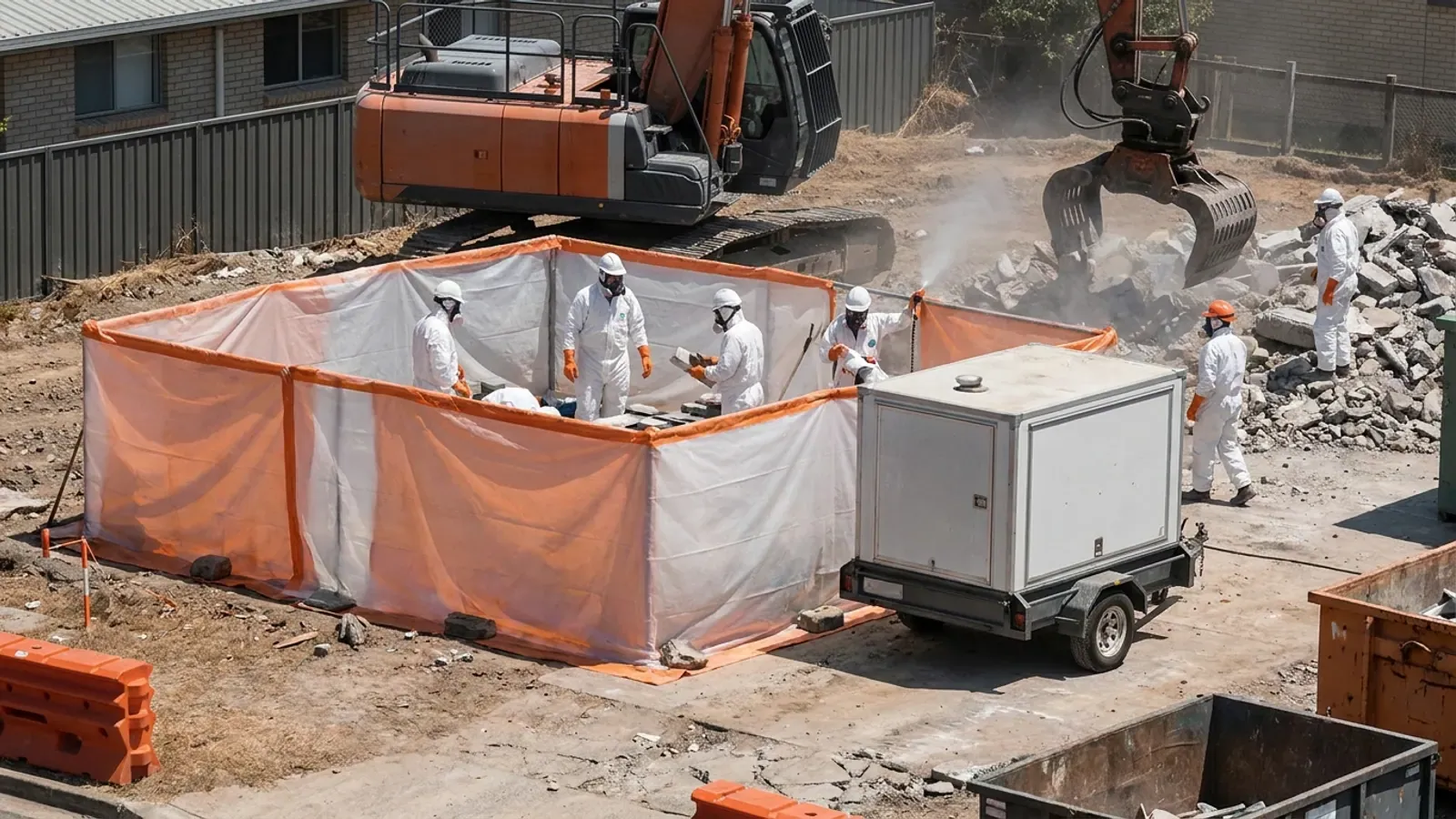
If a building on the Gold Coast predates the phase-out of asbestos-containing building products, the asbestos scope is usually the item that determines when demolition can start. Not the approval. Not the machine availability. The asbestos.
This page explains the sequence so you know what to ask for and why the order matters.
Before anything else: do not attempt to identify, disturb, break, sand, drill, water-blast or dispose of suspected asbestos-containing material yourself. This page is general information about the process, not instruction to carry out any part of it.
Why removal comes first
WorkSafe Queensland guidance is that asbestos should be removed before demolition so far as is reasonably practicable.
The logic is straightforward. Demolition breaks material up and disperses it. Doing that to asbestos-containing material creates a hazard that is far harder to control than removing the material intact beforehand, under containment, by someone licensed to do it.
The practical consequence for your project: the removal scope, its licensing requirement and its clearance step all sit ahead of the structural work in the programme.
The four-step sequence
1. Identify
A competent person assesses the building, or an existing asbestos register is reviewed.
For commercial buildings, a register may already exist and should be provided early — it turns the removal scope from something discovered into something planned.
For residential properties there is usually no register, and an assessment is the starting point. Age is an indicator, not a determination: a building of a certain era is more likely to contain asbestos-containing material, which is a reason to assess it, not a conclusion about what is there.
Identification is a specialist task. Nobody should tell you what material is from a photograph or a description, including us.
2. Remove under licence
Removal is carried out by an appropriately licensed removalist. At a high level:
- Friable asbestos requires a Class A licence.
- Removal of more than 10 square metres of non-friable asbestos requires a Class A or Class B licence.
The precise scope permitted under each class is set out in WorkSafe Queensland’s asbestos licensing guidance, and the removalist can confirm what their licence covers for your specific job. Ask them directly — a licence class is a factual thing they can state.
What removal involves on site: containment appropriate to the material, decontamination arrangements, controlled access, and wrapped waste going to a facility licensed to receive it, with the required transport and documentation. On a tight residential block or an occupied commercial site, that setup can be more constrained than the demolition that follows it.
3. Clearance
After removal, the area is assessed as suitable for the next stage of work or for reoccupation.
Clearance requirements depend on the type and scale of the removal. Confirm what applies to your job with the licensed removalist, and confirm what documentation you will receive at completion — a certifier, builder or head contractor may need it before the next stage begins.
4. Demolish
Structural demolition proceeds once the asbestos scope is complete.
Note that the demolition work itself carries its own obligations: some demolition work must be notified to Workplace Health and Safety Queensland at least five days before it commences, and some demolition work requires a demolition work licence.
Where asbestos-containing material commonly turns up
Not as a checklist for you to inspect — as context for why an assessment covers more than the obvious.
Residential: external and internal wall sheeting, eaves, roof sheeting, fencing, wet-area linings, vinyl floor tiles and their adhesives, and backing behind later finishes.
Commercial and fitout: vinyl tiles and adhesives, sheet linings hidden behind subsequent refits, mastics, gaskets and some fire-rated board.
Rural and outbuildings: machinery shed walls and roofing, in particular. On established holdings the sheds are frequently a higher-risk structure than the dwelling.
Why “found something unexpected” is expensive
Material discovered inside a wall cavity or under a later finish, mid-demolition, stops the work while it is assessed. Plant sits idle, the crew stands down, and the removal scope has to be arranged from a standing start.
An upfront survey costs a fraction of that. Where a building is old enough for asbestos to be a genuine possibility, the assessment is the cheapest insurance in the project.
If material has already been disturbed
Stop. Do not continue working, do not clean it up yourself, and do not dispose of it with general waste. Seek advice from an appropriately licensed party. Where there is an immediate danger, contact the relevant authority.
What we do and do not do
Demolition Gold Coast does not hold asbestos removal licences and does not remove asbestos. We do not identify material, and we will not tell you over the phone whether something is asbestos.
What we do is take the enquiry, understand where the asbestos scope sits in your project, and — where it matches — share the enquiry with a suitable independent provider who holds the relevant capability, so they can contact you about the work.
What happens next
Call and describe the building, its approximate age and whether any assessment already exists. That is enough to work out whether it is something that can be matched to a provider with the right licensing.