Demolition guide
Demolition Approvals and Permits on the Gold Coast
Three separate approval layers, who confirms each one, and why your neighbour's approval path does not transfer to your block.
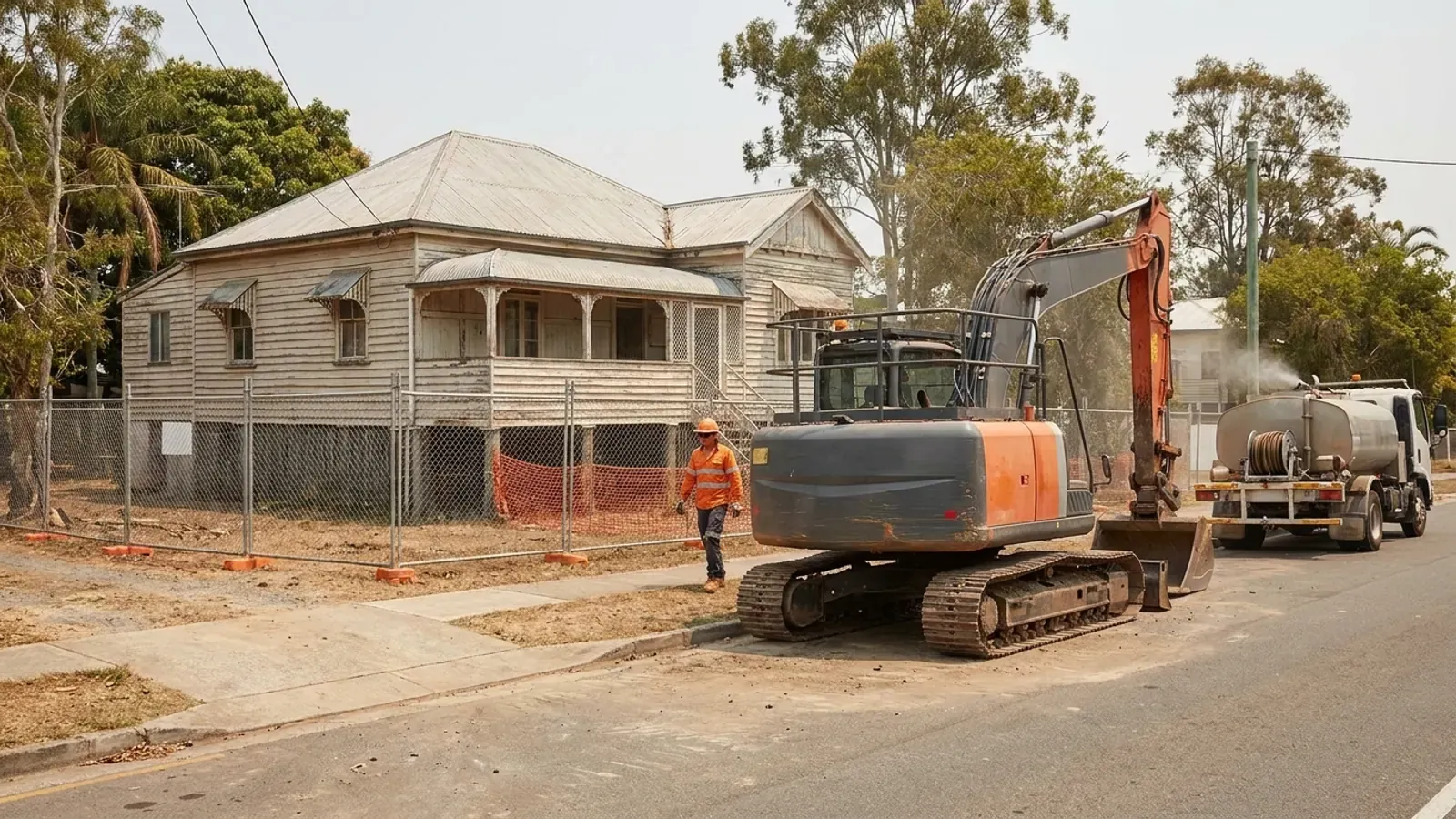
The most common mistake people make with demolition approvals is assuming there is one approval.
There are usually three separate layers, confirmed by three different parties, running on three different timelines. Understanding which is which saves weeks.
The three layers
1. Building approval for the demolition. Property- and scope-specific. Confirmed by a licensed building certifier.
2. Work health and safety obligations for the work itself. Set by the structure and method, not by your property. These attach to whoever performs the work.
3. Building management or body corporate approval. Applies to work in apartment buildings, commercial towers and townhouse complexes. Entirely separate from council, with its own application and lead time.
Miss any one and the job stops.
Layer 1: building approval
Whether demolition needs an approval — and what kind — depends on your specific property. The factors include:
- The zoning that applies to the land
- Any overlays affecting it, which can relate to character, heritage, flooding, coastal hazard, vegetation and more
- The age and character of the building
- The scope of the work: whole building, part of it, or internal only
This is exactly why your neighbour’s approval path does not transfer to your block. Two adjoining properties can sit under different overlays. A demolition that was straightforward next door can be a different assessment on your title.
A licensed building certifier is the right party to confirm what your property needs. They do this professionally, they carry the responsibility for getting it right, and engaging one early is the cheapest step in the whole project. City of Gold Coast property and planning information covers what applies to the land, and the Queensland Government publishes an overview of how development assessment works.
Records held by the City of Gold Coast show that demolition approvals for individual properties are commonly assessed and archived through private certifiers, across suburbs from Burleigh Heads to Upper Coomera. That is useful evidence that property-specific approval records exist and that certifiers are the normal route — it is not evidence that any particular rule applies to your block.
What a certifier will want
- The property address and title details
- What is being demolished, precisely — a marked-up plan or a clear sketch
- Whether anything is being retained
- The proposed method, where it affects the assessment
- Details of the party carrying out the work
Layer 2: work health and safety obligations
This layer is often missed by owners, because it attaches to the work rather than the property.
Two things are worth knowing:
- Notification. Some demolition work must be notified to Workplace Health and Safety Queensland at least five days before it commences.
- Licensing. Some demolition work requires a demolition work licence.
Whether your scope triggers either depends on the structure and the method used. The licensed provider carrying out the work is responsible for meeting these obligations and is the right party to confirm which apply. Confirm current requirements against WorkSafe Queensland guidance rather than relying on general summaries, including this one.
If asbestos is involved, a further set of requirements applies to the removal work — see asbestos before demolition in Queensland.
Layer 3: building management and body corporate
For internal works in apartment buildings, commercial towers and townhouse complexes, this layer is frequently the one that actually delays the start.
Typical requirements:
- A works application to building management or the body corporate
- Contractor induction for everyone entering the building
- Evidence of insurance, sometimes naming specific parties
- An approved method and programme
- Protection of common areas — lobbies, lifts, corridors
- Defined permitted work hours
- Goods lift and dock bookings
- Sometimes a bond or deposit
These are sequential rather than parallel, and each has a lead time. Trades routinely lose a scheduled week to paperwork they assumed could be done on the day.
The sequence that avoids delay
The physical demolition of a straightforward detached dwelling is short. Everything ahead of it is not. Run these in parallel, starting immediately:
- Engage a certifier to confirm the approval path
- Apply for service disconnections — usually the longest lead item of all
- Arrange a hazardous-materials assessment if the building is old enough to warrant one
- Start building-management applications if the work is inside a managed building
- Confirm who is meeting the work health and safety obligations for the work itself
Only once those are resolved does a realistic start date exist.
What this page is not
This is general information about how the approval layers usually work. It is not advice about your property, it is not a determination that any particular approval is or is not required, and it does not replace a licensed building certifier. Requirements change and are specific to each site and scope.
What happens next
Call to talk through the scope. We can tell you which layers are likely to be in play for the kind of project you are describing, and where the enquiry matches, it may be shared with a suitable independent provider who can confirm the work health and safety side from their own licensing position.